Quality & Engineering
Every component that leaves Supco Canada's facility in Maple, Ontario undergoes a documented, multi-stage quality verification process. Our internal testing protocols are designed to meet or exceed OEM specifications — ensuring each aftermarket part performs to the same tolerances as the original.
Engineering to OEM Specifications
Supco Canada sources and manufactures aftermarket locomotive components engineered to match OEM dimensional specifications, material grades, and electrical ratings. Every part number in our catalog is referenced against original manufacturer drawings or sample measurements, and tolerances are held across production batches under our ISO 9001:2015 Quality Management System.
OEM Specifications
All components are engineered to match original manufacturer dimensional, electrical, and material specifications. OEM part numbers are cross-referenced to verify compatibility before production.
Dimensional Tolerances
Critical fits — such as bearing seats, gear bores, and commutator diameters — are held to OEM tolerances using calibrated measuring instruments. All gauges are maintained under a calibration schedule traceable to national standards.
Material Traceability
Incoming raw materials and sub-components are verified against purchase specifications and stored with material certification records. Full traceability is maintained from raw stock to finished component.
How We Test Every Component
Each product type has a defined test procedure documented under our ISO 9001:2015 QMS. Testing is performed by trained technicians using calibrated equipment. Results are recorded and retained as quality records.
Electrical Testing
| Test | Method | Pass Criteria |
|---|---|---|
| High Potential (HiPot) | AC/DC dielectric withstand voltage applied between winding and frame | No breakdown at rated test voltage (per OEM spec) |
| Insulation Resistance (IR) | 500 V or 1,000 V Megger test — winding to frame | ≥ 1 MΩ minimum; ≥ OEM baseline for class |
| Winding Resistance | 4-wire milliohm measurement at ambient temperature | Within ± 5% of OEM specification |
| Armature Balance | Dynamic balance on precision balancing machine | Residual imbalance within OEM tolerance (g·mm/kg) |
| Load / Dynamometer | Motoring or generating load test at rated conditions | Output within ± 2% of rated parameters |
Dimensional & Mechanical Testing
| Test | Instrument | Tolerance Held |
|---|---|---|
| Bearing Seat Diameter | Calibrated bore gauge / CMM | ± 0.005 mm (H7/k6 or per OEM drawing) |
| Gear Bore & Tooth Profile | Gear checking machine / Go-NoGo gauges | AGMA Class 10 or OEM equivalent |
| Commutator Runout | Dial indicator on lathe centres | TIR ≤ 0.025 mm (OEM spec) |
| Surface Finish | Profilometer (Ra / Rz measurement) | Ra ≤ 0.8 µm on bearing journals |
| Shaft Straightness | Precision vee-blocks & dial indicator | ≤ 0.02 mm full length |
Durability Testing
Durability testing validates that components will withstand the mechanical and thermal loads of in-service locomotive operation. Key durability protocols include:
- ✓ Thermal cycling: winding systems exposed to rated temperature cycles to verify insulation class (Class F 155°C / Class H 180°C) before release.
- ✓ Vibration resistance: mechanical assemblies verified for fastener torque retention and joint integrity after vibration simulation.
- ✓ Gear set fatigue: axle gears and pinions are surface-hardness checked (Rockwell HRC) and tooth geometry verified after heat treatment.
- ✓ Bearing run-in: bearing assemblies are run at rated speed under load to verify temperature stability and noise levels.
- ✓ Brush and commutator wear simulation: carbon brushes are tested for correct grade, spring pressure, and seating surface conformance.
Final Inspection & Quality Release
No component ships without a completed inspection record signed by a qualified inspector. Our quality release process includes:
| Stage | Requirement |
|---|---|
| Receiving Inspection | Material certs verified; incoming dimensions spot-checked |
| In-Process Inspection | Hold points at critical operations per routing card |
| Electrical Final Test | HiPot + IR + resistance — all results recorded |
| Dimensional Final | Key fits and surfaces measured; values recorded on traveller |
| Visual Inspection | Surface condition, cleanliness, marking, and labelling checked |
| Document Package | Test records, material certs, and COC issued with shipment |
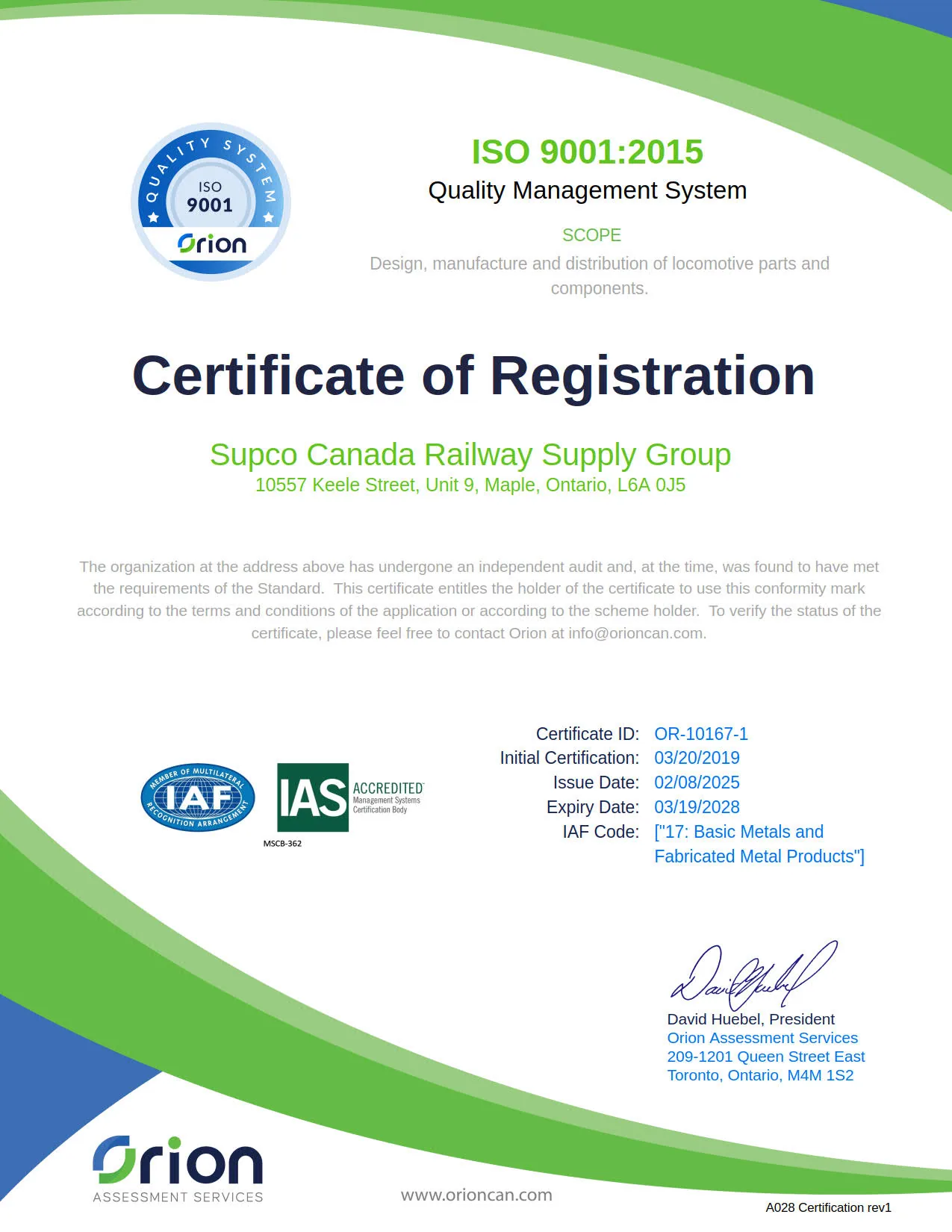
ISO 9001:2015 Certification
Supco Canada has maintained ISO 9001:2015 certification continuously since 1999. Our Quality Management System governs every aspect of design review, purchasing, production, inspection, and corrective action. Third-party surveillance audits are conducted annually to verify ongoing conformance.
- ✓ Documented control of all manufacturing and testing procedures
- ✓ Calibration program for all inspection and test equipment
- ✓ Supplier evaluation and approved vendor list (AVL)
- ✓ Non-conformance reporting and corrective action (CAPA) system
- ✓ Customer feedback and complaint resolution process
- ✓ Internal audit program with management review
- ✓ Continual improvement driven by quality metrics and KPIs
Questions About Our Quality Standards?
Our technical team can provide component-specific test reports, material certifications, and quality documentation on request. Contact us to discuss your specification requirements.